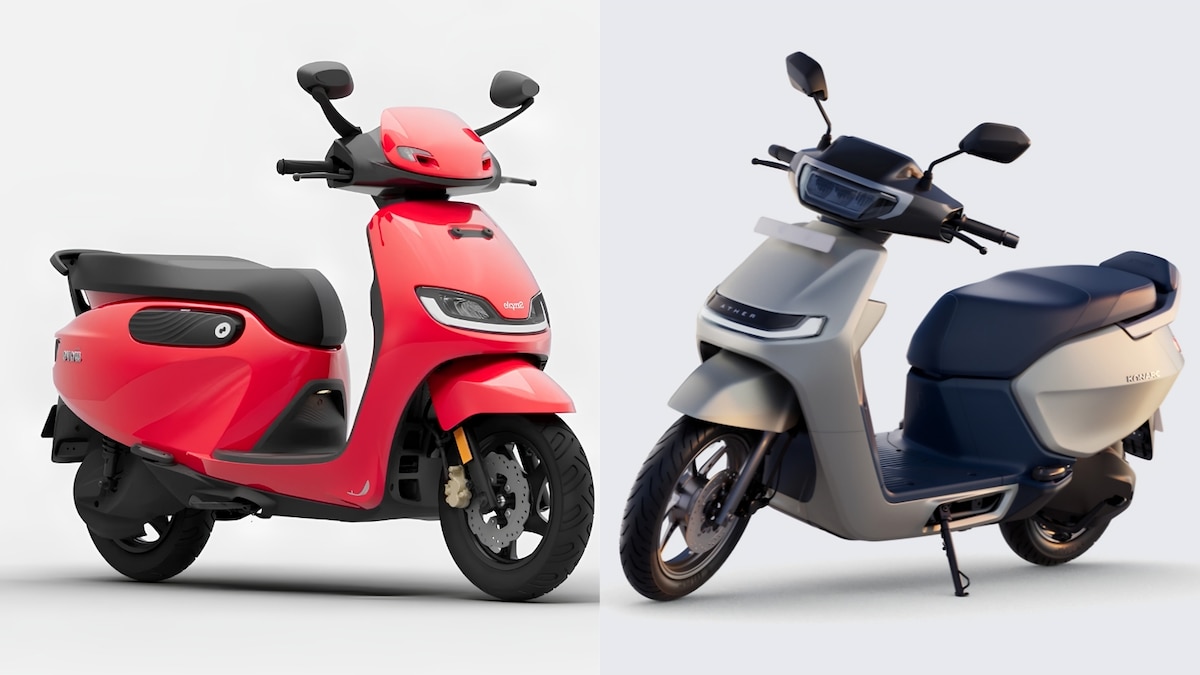
The Bengaluru EV battle just got properly interesting. Simple Energy has rolled out the Wave, its family-focused electric scooter, and it lands in the same shopping basket as Ather’s new Konarc. For buyers who were already cross-shopping the Rizta, TVS iQube and even value-oriented electric scooters like the Simple Energy Wave’s launch siblings in the broader EV space, this is exactly the kind of rivalry that forces brands to sharpen their game.
Prices, variants and where the two scooters stand
Simple has introduced the Wave at an introductory ₹1.09 lakh, ex-showroom. The company has said the headline price is for the base model, while higher trims will be priced separately. Deliveries are scheduled to begin from 25 September 2026.
Ather’s Konarc, meanwhile, starts at ₹99,999 ex-showroom for the S 100 and goes up to ₹1.45 lakh for the S 161, ex-showroom Bengaluru. The more premium Z variants have been promised for 2027. The Konarc S 125 and S 161 are slated to go on sale in September 2026.
That makes the comparison more nuanced than the sticker price suggests. Simple is asking a bit more at entry level, but it also claims to pack in a stronger motor, bigger battery options and a huge storage advantage. Ather, as usual, plays the software-and-platform card with multiple configurations and a more mature feature ecosystem.
If you want a broader sense of how this segment is shaping up, our earlier coverage of the Ather Konarc launch and the latest family scooter launches shows just how aggressively brands are chasing commuter upgrades in India right now.
Battery, range and charging
This is where Simple makes its loudest statement.
The Wave comes in three broad variants — Wave S, Wave and Wave+ — spread across six configurations. Battery choices start with 2.2kWh and 2.7kWh packs on the Wave S, with claimed IDC range of 110km and 132km. The regular Wave gets a 3.7kWh battery with a claimed 171km range, while the top Wave+ uses a 5kWh battery and is claimed to deliver 243km on the IDC cycle, which Simple says is the highest in the segment.
Ather’s Konarc S range is more modest on paper. The S 100, S 125 and S 161 use 2.1kWh, 2.7kWh and 3.5kWh batteries respectively. Claimed IDC range figures are 100km, 125km and 161km, though Ather’s own TrueRange numbers are lower at 80km, 100km and 130km.
Charging speeds also favour Simple in standard form.
- Wave S: 0-80% in as little as 70 minutes with the base setup
- Wave/Wave+: 0-80% in up to 2 hours 15 minutes with the included 750W charger
- Konarc S 100/S 125/S 161: 0-80% in 4 hours, 4 hours 30 minutes and 5 hours 40 minutes with the standard 450W onboard charger
- Konarc can be sped up with an optional 900W off-board charger, cutting those times to 2 hours, 2 hours 25 minutes and 3 hours 10 minutes
Simple’s batteries are mostly LFP units, with the Wave+ switching to an NCA pack. All packs are IP67 rated and the company claims 300mm water-wading ability.
Motor, speed and real-world intent
There’s a clear difference in personality here.
The Wave uses a 6.4kW PMSM motor with 179Nm of wheel torque, although the entry Wave S EBN gets a smaller 4.5kW unit. Simple says the scooter does 0-40kmph in 3.3 seconds. Top speed is 75kmph for the Wave S and 90kmph for the Wave and Wave+.
Ather keeps things calmer. The Konarc S 100 makes 4kW and 16Nm, while the S 125 and S 161 make 4.7kW and 16Nm. All three are limited to 70kmph.
For buyers, that matters more than a spec-sheet flex. If your commute includes open stretches, flyovers or the odd quick overtake, the Wave’s extra punch and higher top speed should be noticeable. If your riding is mostly urban and you value efficiency, lower running costs and a more predictable pace, the Konarc’s performance will likely feel sufficient.
Storage, comfort and day-to-day practicality
Here Simple absolutely leans into the family scooter brief.
It claims 70 litres of total storage — 63 litres under the seat, 3 litres in a glovebox and another 4 litres in a side pocket called the Pill, which can be accessed while seated. That is a serious number for a scooter, and exactly the sort of thing Indian households will use every day. Another Pill pocket can be bought as an accessory.
The Konarc offers a 31-litre underseat boot, which is decent but nowhere near as generous. It does get an 18W USB Type-C port and an underseat lamp.
Dimensions tell a similar story of compromise and packaging.
Simple has given the Wave a 920mm seat, which it calls the longest in India, a 775mm seat height and 175mm ground clearance. It rides on 12-inch alloy wheels at both ends, with telescopic front forks and twin rear shocks.
Ather’s scooter gets a 1,352mm wheelbase, a 14-inch front wheel and 12-inch rear wheel, along with monoshock rear suspension. On paper, the Konarc looks a touch more premium in its cycle parts, while the Wave focuses more on space and easier accessibility.
Brakes, features and connected tech
Both scooters aim at the feature-conscious urban buyer, but they take different routes.
The Wave uses a 220mm front disc and rear drum, with CBS across the range. Higher variants get traction control through Simple’s GripSense setup. Safety features include DropSafe, which cuts motor power if the scooter tips, Super Hold for inclines, reverse, crawl and Limp Home modes. Higher trims also get GPS, Wi-Fi and OTA updates, plus a 7-inch TFT display powered by an Arm Cortex-M85 chip. Lower variants use a 5-inch InfiniteBlack segment display.
Ather’s Konarc S 100 gets drum brakes at both ends, while the S 125 and S 161 use a 220mm front disc and 130mm rear drum. The display story depends on the variant: 4.2-inch on the S 100, 7-inch on the higher trims. Ather Connect brings theft and tow alerts, ride stats and remote charging-status monitoring.
The more advanced Z variants, due later, will bring AEBS, AutoHold, Park Assist reverse and app-based boot access via MagicKey. That sounds promising, but for now those features remain future-facing rather than purchase-ready.
Simple’s app adds location sharing, geofencing, theft alerts and roadside assistance calling. It’s a fuller pitch than before, though some functions are tied to subscription plans, just as Ather’s StackPro requires a one-time payment for advanced connected features.
Platform, production and why Simple is suddenly making noise
Simple says the Wave uses an updated version of the One’s platform, with a wider rear frame and a repackaged motor and transmission to free up storage space. The motor is built in-house and doesn’t use rare-earth materials, which is an important talking point in the current EV supply-chain climate.
On the business side, the timing matters. According to TOI, Simple is currently seeing demand of 3,000-4,000 scooters a month but is only delivering around 1,500-2,000, leaving a backlog of roughly 2,000-2,200 units. The company says output should improve from the end of September or in October as supplier capacity and manufacturing ramp up.
That’s a useful detail for buyers. A flashy launch is one thing; getting scooters out the door is another. Simple says it has more than 75 exclusive outlets across over 60 cities and aims to scale further, while Ather’s Konarc is being built on the company’s new EL platform, developed using data from 26 lakh km of testing.
For readers tracking the wider electric two-wheeler market, this is another sign that the segment is moving beyond just range claims and into proper family-use practicality. It also arrives alongside other notable launches such as the Royal Enfield Himalayan 440 and the Jawa 42 FJ All Stars, which shows how crowded the Indian two-wheeler market has become across categories.
So, which one suits whom?
If your priorities are sheer storage, stronger performance and a longer claimed range, the Wave looks like the more ambitious package. If you want a slightly lower entry price, multiple variants and Ather’s established connected-tech reputation, the Konarc makes a compelling case.
And that is really the whole story. These two scooters are not trying to be the same thing. Simple is going big on practicality and numbers, while Ather is building a cleaner, more structured ladder of variants around the family scooter idea. The right pick will depend less on one headline figure and more on whether you value boot space, top speed, charging convenience or the comfort of a familiar software ecosystem.