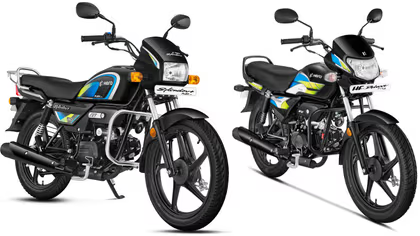
Hero MotoCorp’s flex-fuel gamble is getting an encouraging early response. The company says bookings for its E85-compliant motorcycles are now close to 10,000, with the biggest demand coming from the Splendor+ E85 and HF Deluxe E85 duo that debuted in June 2026.
That matters because these are not niche premium experiments. They are mass-market commuters, the kind that actually decide whether a new fuel technology spreads beyond brochures and policy presentations. Hero’s logic is simple: put the bikes on the road first, and the fuel network should follow. In theory, it is a chicken-and-egg problem with a very practical answer.
Ashutosh Varma, Chief Business Officer – India Business Unit, said Hero has “over 10,000 inquiries” and bookings are nearly at the same level as availability improves. He also framed flex-fuel as more than a compliance exercise. For Hero, it is shaping up as a growth lever for the internal combustion engine portfolio, not a side project.
Why Hero thinks E85 can work in India
The pitch is easy to understand if you shop in the commuter segment. Hero’s E85 bikes can run on ethanol-blended petrol from E20 up to E85. That means they can use the fuel that is already widely available today, while also being ready for higher-ethanol blends as the network grows.
At the moment, that network is still thin. E85 pumps are available only at select locations, including parts of Delhi-NCR, so buyers in most cities will have to wait for the ecosystem to catch up. Hero admits that fuel availability is the real gating factor, not product readiness.
The company’s move also mirrors the broader policy push around ethanol blending. With the government encouraging more alternative-fuel adoption, Hero is clearly positioning these bikes as future-proof commuters rather than short-term oddities.
For buyers, that has a few implications:
- lower running cost if E85 availability increases
- stronger compatibility with government fuel policy
- slightly higher output than the standard petrol versions
- less dependence on pure petrol prices over time
Hero says the E85 versions are engineered with a new fuel pump, secondary fuel filter and a recalibrated ECU map. Output is up too: the company claims around 7% more power and 3% more torque compared with the conventional versions.
Prices and positioning
The E85-ready Splendor+ and HF Deluxe were launched in June at ex-showroom Delhi prices of ₹82,810 and ₹72,792 respectively. That keeps them squarely in commuter territory, where every rupee matters and rivals are judged as much on fuel efficiency and reliability as on headline specs.
Against that backdrop, the obvious cross-shoppers are not performance bikes but the regular workhorses of the 100cc-110cc class: Hero’s own petrol Splendor and HF Deluxe, plus models like the TVS Radeon and Bajaj Platina. Buyers looking at total ownership cost will also compare them with simple electric scooters if their use case is short and urban, especially as the market broadens through models like the Simple Wave vs Ather Konarc comparison era of family-friendly EVs.
Hero sells around 45-50 lakh units annually of the Splendor and HF Deluxe family together, which shows why this strategy matters. Even a small conversion rate in such a massive volume pool can turn flex-fuel into a serious business line.
EVs, flex-fuel and the ICE portfolio
Hero’s stance on electrification is just as interesting as its E85 push. The company does not see EVs as a replacement for ICE sales right now. Instead, it views electric scooters and flex-fuel motorcycles as additions to the portfolio.
That is a fairly pragmatic view of the Indian two-wheeler market. Fuel choices will evolve unevenly, charging will improve at different speeds across cities and towns, and buyers will keep choosing based on use case rather than ideology. Hero seems happy to serve all of them.
Varma said electric scooters could reach the volume scale of ICE scooters by 2031. Until then, the company is keeping its options open and scaling capacity in line with demand. That flexibility may prove more useful than any single powertrain bet.
There is also a broader industry signal here. A commuter motorcycle that can run on a cleaner, more future-proof fuel blend gives manufacturers one more way to defend petrol models while government rules tighten. It is not replacing ICE, but it could help prolong the category’s relevance in markets where buyers still want range, ease and low upfront cost.
Hero’s early booking numbers suggest the message is landing. Whether E85 becomes a real-volume story will depend on how quickly India’s fuel infrastructure expands beyond a handful of stations. Until then, these bikes will remain a strong idea with a very practical bottleneck.