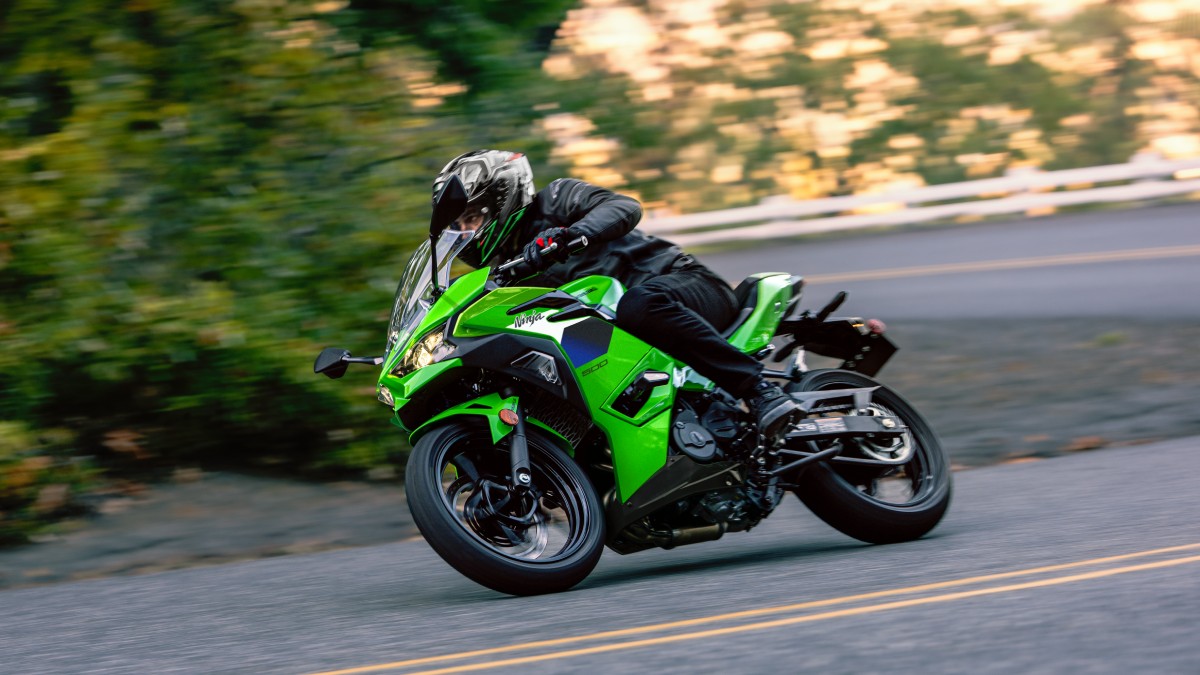
Kawasaki India has rolled out the 2027 Ninja 500 at Rs 5.76 lakh ex-showroom, and this is very much a model-year update rather than a proper refresh. If you are expecting new hardware, extra features or even a revised price tag, there’s nothing of the sort here. It is the same Ninja 500 sold under a new year stamp, with bookings now open at Kawasaki dealerships across the country.
The only obvious visual change is the familiar Lime Green paint scheme with updated model-year graphics. For a bike that sits in premium territory, that keeps the attention on its badge more than any real novelty. There is no new colour palette, no bodywork tweak and no equipment bump. Even the turn indicators continue to be halogen units, which feels dated at this price.
What the Ninja 500 still gets
Mechanically, the 2027 Ninja 500 carries forward the same 451cc liquid-cooled parallel-twin engine. Output stays at 45 PS and 42.6 Nm, and the motor is paired with a 6-speed gearbox and an assist and slipper clutch. That means smooth clutch action in traffic and a little extra reassurance when you get enthusiastic on downshifts.
Kawasaki’s official India website still lists the Ninja 500 as a twin-cylinder sports bike aimed at everyday usability, and that remains the bike’s strongest card. It is not built to be a hard-edged supersport. Instead, it combines approachable ergonomics with enough punch to feel genuinely quick in the city and on a weekend run.
The chassis package is equally familiar: a lightweight trellis frame, telescopic front fork, rear monoshock, 17-inch alloy wheels and disc brakes at both ends with dual-channel ABS. The bike weighs 171 kg in BikeWale’s listing, while the model data shown by Kawasaki references a kerb weight of 176 kg. Either way, it stays manageable for a middleweight twin.
Features remain basic for the price
This is where the Ninja 500 starts to lose some shine. The instrument panel is still a high-contrast LCD display, and the motorcycle gets smartphone connectivity on the higher-spec trim, along with Kawasaki Rideology support, call and notification alerts, riding logs and vehicle info. The base package, however, is not especially generous when you compare it with newer rivals.
There is no TFT display, no keyless system and no ride modes in the Indian-spec bike. That matters because the segment has moved on quickly, and buyers shopping in this bracket tend to expect more electronics for the money. The standard equipment list is adequate, but not class-leading.
The practical numbers are still decent: 785mm seat height, 145mm ground clearance and a 14-litre fuel tank. Those figures should make the Ninja easier to live with than a full-on track-focused machine, and the riding position should continue to suit commuters who also want weekend fun. If you want a slightly broader price-and-spec context, our earlier Ninja 500 launch coverage showed how Kawasaki positioned this bike in India from the start.
Why the value question keeps coming up
At Rs 5.76 lakh ex-showroom, the Ninja 500 is firmly in expensive territory for a 500cc faired motorcycle. That is especially true when you look at the strongest rival: the Aprilia RS 457. The Aprilia offers more power, richer hardware and a more modern feature set, while also undercutting the Kawasaki on price.
That comparison makes the Ninja 500 a hard sell for anyone shopping purely on spec sheets. It does have the advantage of a parallel-twin motor, which should appeal to riders who prefer smoothness and refinement over a single-cylinder thump. And the Kawasaki badge still carries a certain pull. But Indian buyers tend to be brutally practical in this segment, and they will notice what the numbers say.
The closest alternatives will also include the Aprilia RS 457 — no, not that link; in buying terms, the real cross-shopping is with the RS 457, Yamaha R3 and KTM RC 390. The Suzuki GSX-8R sits in a different price band entirely, but it is worth mentioning because many buyers will stretch budgets while hunting for a serious road-biased sports bike. BikeWale already lists the Ninja 500 [2026] against the GSX-8R, which underlines how the Kawasaki often gets pulled into bigger-bike comparisons despite its smaller capacity.
No changes where it matters most
The bigger disappointment is that Kawasaki has not used this model-year update to address the bike’s weak spots. The headlight setup is still twin LED projectors, the tail lamp remains LED, and the package is otherwise untouched. India continues to receive the standard Ninja 500, not the better-equipped Ninja 500 SE sold in some overseas markets. That SE version brings a colour TFT screen and Kawasaki’s KIPASS keyless system, both of which would have made this update feel more substantial.
Autopunditz notes that the MY2027 model is basically a rollover with the same price, same mechanicals and the same kit. That sums it up neatly. There is nothing wrong with the Ninja 500 as a motorcycle; it is refined, usable and easy to like. The issue is that the market around it has become sharper, more aggressive and more feature-rich.
If you want a middleweight faired bike with a twin-cylinder character and a comfortable riding posture, the Ninja 500 still makes sense on paper. But if you are paying close to Rs 6 lakh ex-showroom, you will almost certainly compare it with the Aprilia RS 457, the Yamaha R3 and even KTM’s RC 390 before signing on the dotted line. And in that crowd, the Kawasaki has to win the argument on feel, not on features.